
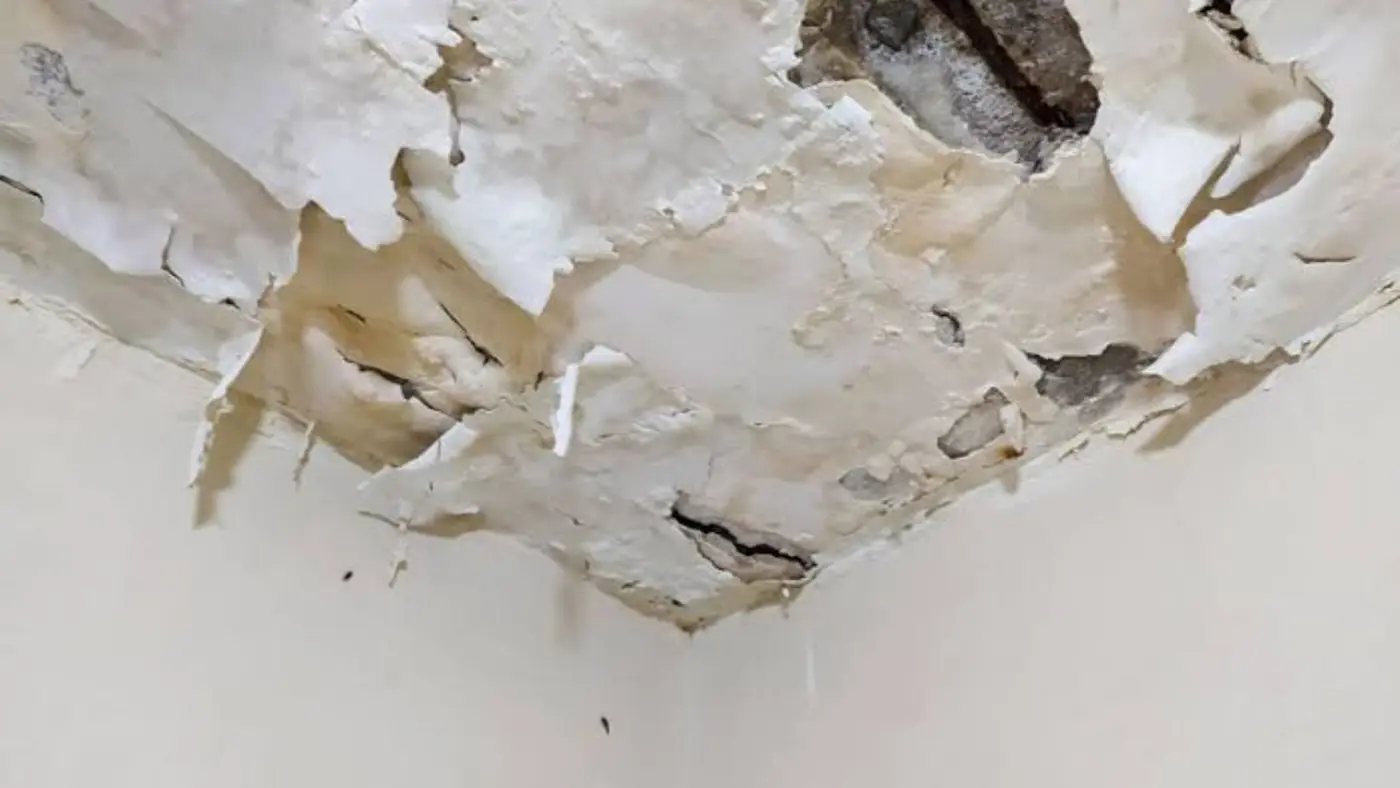
Repair comes after the ceiling is dry
Ceiling repair starts when moisture readings match an unaffected part of the house and the leak has been fixed. A stain by itself is not a reason to patch. If the drywall still reads wet, closing it up only hides a problem that can come back as mold or a sagging panel.
This guide assumes the emergency work is done. For the water response itself, see our cleanup service. What follows is the rebuild, in the order a good crew does it.
Step one: assess what is actually damaged
A technician checks the ceiling from below and, where possible, from the attic. Moisture meters show whether any drywall is still wet, and a tap or light press finds soft spots. The size of the stain on the surface often understates the damage, because water spreads along the back of the board.
The assessment decides the rest of the job. A small, dry, firm stain may need only stain blocking and paint. A swollen or crumbling area needs to come out, and a large one may call for a whole panel.
Patch or replace the panel
| Condition of the ceiling | Usual repair | Reason |
|---|---|---|
| Dry, firm, light stain only | Stain block, prime and paint | The board is sound and only needs sealing |
| Small soft or bubbled patch | Cut out and patch | Only a limited area is weakened |
| Sagging or cracked across a panel | Replace the panel | A patch would not hold or hide the sag |
| Wet insulation above the stain | Remove insulation, then repair | Wet insulation holds water against the board |
| Stain keeps coming back | Stop and re-check the source | The ceiling is not the problem |
A patch is quicker and disturbs less of the room, but a large patch is harder to hide, especially under raking light from a window. Replacing a full panel from joist to joist can give a cleaner result when the damage runs close to a seam.
Ready to get the ceiling rebuilt?
Call dispatch any hour. We will check that the area is dry, walk you through patch versus replace and give you a written scope for the rebuild.
Call (909) 505-3870Step two: cut out the damaged section
Crews mark a clean rectangle that reaches past the damaged area and lands on a joist or a backer strip. Dust control matters here, so floors are covered and the work is vacuumed with a HEPA filter. If the ceiling was textured long ago, ask for a quick check before cutting since older finishes can contain materials that need special handling.
The cut-out piece is bagged and removed. Wet or crumbled drywall is not saved. The edges should be straight and solid so the new board sits flush.
Step three: insulation and framing
With the board open, the attic space is visible. Insulation that was soaked is removed and replaced, since it rarely springs back to its original performance. Joists and framing are checked with a meter, and anything still damp is dried before closing.
If the cause was a roof leak, this is a good time to confirm the roofer's repair from the inside. If it came from plumbing, a plumber should confirm the pipe or fitting is secure before new drywall goes up.
Step four: hang and finish the drywall
New drywall is cut to fit, screwed to the joists or backers and its seams are taped. Joint compound is applied in thin coats and sanded smooth between coats, which takes time because each coat must dry. Rushing this stage is the main reason patches show later as ridges or cracks.
Ceilings often take a few visits for this reason. The drywall work is also where a permit question can come up if the repair involves anything beyond patching, so ask the city building department when in doubt.
Step five: match the texture
Popcorn, orange peel, knockdown and smooth finishes each need a different technique. Matching is part skill and part trial. A good crew sprays or hand-applies texture on a test board first and compares it under the room's real light.
Blending the edge into the surrounding ceiling is what makes a repair vanish. If the existing finish is heavily aged or discolored, matching it exactly is often impossible, which is why painting the whole ceiling usually looks better than painting only the patch.
Step six: prime and paint
A stain-blocking primer seals the patch and any remaining stain so it does not bleed through the topcoat. Then ceiling paint goes on, usually across the entire ceiling plane, ending at a natural corner or break. Two coats are common.
Allow the paint to cure before you hang anything or run a heavy shower fan. Our water damage repair crews handle the whole chain, from cutting out through paint.
Roof leak stain versus plumbing leak stain
A roof leak stain usually appears or grows after rain, sits below a roof edge, penetration or valley, and may be accompanied by damp attic insulation. A plumbing leak stain stays wet in dry weather and tends to sit beneath a bathroom, kitchen or laundry. Identify which you have before any repair, because the wrong fix brings the stain back.
A stain from clean supply water is often simpler to repair than one from a drain line or an overflow, which may need removal of more material.
Water Damage Notes for Loma Linda
The Contractors State License Board says work totaling $1,000 or more in labor and materials needs a California contractor license, and work under $1,000 still needs one if it requires workers or permits. Ceiling rebuilds often pass that line quickly once insulation, drywall and paint are added together.
Before you sign, ask any company for its license number and check it on the board's website yourself. We do not state a license number on this page, so the check is yours to run for every bidder, including us.
We take ceiling repairs in nearby Highland homes and Redlands neighborhoods as well as in Loma Linda.
Ceiling repair questions
How long does a ceiling repair take after drying?
A small patch may take a couple of days because joint compound and paint need time to dry between coats. A full panel or a texture match can take longer.
Can I just paint over a water stain?
Only if the ceiling is dry, firm and the leak is fixed. Use a stain-blocking primer first. Ordinary paint tends to let stains show through.
Why does my ceiling patch show after painting?
Usually the texture or the joint compound edges were not blended, or only the patch was painted. Repainting the full ceiling plane hides the difference.
Does insurance pay for repainting the whole ceiling?
It depends on your policy and the insurer's decision. Document with photos and ask your insurer what it covers before painting.
Do Loma Linda ceiling repairs need a licensed contractor?
California requires a contractor license for work of $1,000 or more in labor and materials, and under that if workers or permits are involved. Check any license on the board's site.